
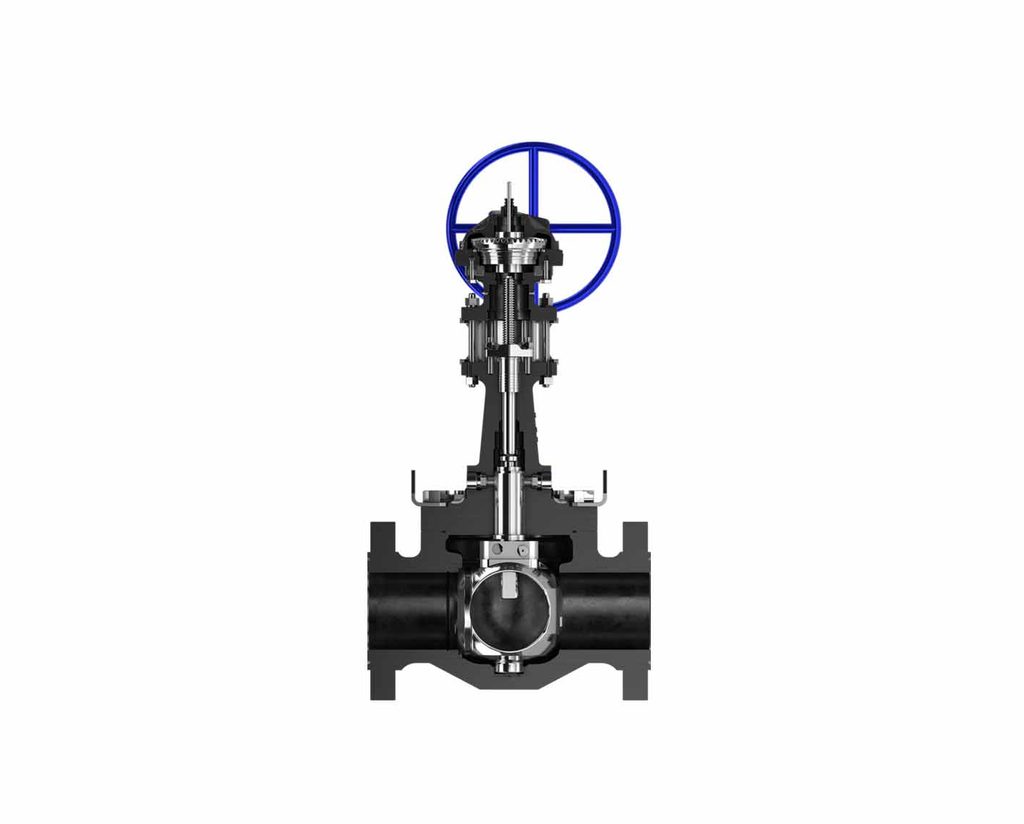
rising stem ball valve
The Orbit™ rising stem ball valve’s unique tilt-and-turn design reduces rubbing between sealing surfaces and delivers reliable performance. It is the proven technology for demanding process conditions, including high-temperature, critical isolation for molecular sieve switching services. This legacy of innovation began with the first patent issued to The Oilwell Improvements Company in 1935. The patented tilt-and-turn design by Alfred Heggem is the forerunner to all ball valves today.
Decades later, the same engineering technology is still used to safeguard against seat rubbing—a leading reason why Orbit valves are world-renowned for high integrity and long service life.
Applications
Ideal for applications that require zero leakage and frequent operation, Orbit rising stem ball valves are used globally in gas processing plants employing molecular sieve systems in switching service. They are also used for
- flowlines
- meter isolation
- dryer switching
- block and bypass
- product segregation
- emergency shutdown
- suction and discharge isolation
- heat-transfer fluids and hot oil
- hydrogen, CCUS, renewable fuels, and ammonia service.
benefits
Every Orbit valve incorporates a proven tilt-then-turn operation that eliminates seat rubbing during both opening and closing. The result is easy, low-torque valve operation and long-term reliable performance.
When the valve is closed, the core is mechanically wedged tightly against the seat, ensuring positive shutoff. When the valve begins to open, the core tilts away from the seat and line flow passes uniformly around the core face, eliminating the localized high-velocity flow that typically creates uneven seat wear in ordinary ball, gate, and plug valves. The core then rotates to the fully open position.
New sealing elements have earned certification to ISO 15848 Tightness Class AH and API Standard 622 for both high- and low-temperature applications. By integrating advanced graphite-based technology with the proven tilt-then-turn operation, Orbit valves have set a new benchmark for fugitive-emissions performance at temperature extremes while increasing valve life even under dynamic cycling conditions.
Features
- No rub between sealing surfaces
- Single-seat design
- Long life
- Optimal flow—high valve flow coefficient (Cv) with full or reduced port openings
- Top-entry design, enabling inline repair
- Dual stem guides
- Self-cleaning
- Low-torque operation
- Wear-resistant hardfacing on core
- Mechanical cam closure
tech specs
Orbit valves were submitted to ISO 15848-1 type testing and earned certification for their industry-leading performance, achieving the best possible ISO 15848-1 tightness class rating of AH at the limits of their design temperature:
- High-temperature packing: ISO FE AH—CO2—SSA 0—t (RT, 400 degC)—CL2500—ISO 15848-1
- Low-temperature packing: ISO FE AH—CO3—SSA 3—t (RT, –50 degC)—CL2500—ISO 15848-1